
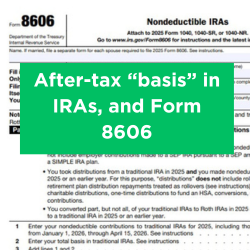
After-tax "basis" in IRAs, and Form 8606
An Individual Retirement Arrangement (or “IRA”) is a type of investment account designed to help people save and invest for retirement.
The Internal Revenue Service (“IRS”) grants IRAs a special “qualified” tax status that allows deferral of taxation on money contributed to, and investment growth that occurs within, IRAs. Generally, IRAs are only taxed when money is distributed from them. Specifically, distributions are taxed as ordinary income in the years they occur.
Additionally, “converting” money from a traditional IRA to a Roth IRA is essentially another form of distribution. As such, Roth conversions are similarly taxed in the year they occur.
Contributions to IRAs can reduce a person’s tax obligation in the year of the contribution as the IRS often allows the contribution to be deducted from that year’s taxable income. For example, if someone has $100,000 of gross income for the year but makes a deductible $6,500 contribution to an IRA, that person’s gross income is then reduced to $93,500 (which means their taxable income is reduced as well).
Considering the money that goes into an IRA is often tax deductible, and considering the gains within an IRA are tax-deferred, it’s said that money inside an IRA is “pre-tax,” in that it has not yet been taxed.
When an IRA contains entirely pre-tax money, the tax implications of taking distributions (or doing Roth conversions) are easy; every dollar that comes out of the IRA is fully taxable as ordinary income in the year it comes out.
However, it’s possible for IRAs to have some already-taxed money in them; IRAs aren’t required to be purely pre-tax money. Already-taxed (aka “after-tax”) money inside an IRA is formally called “basis” in IRS lingo.
You get basis inside your IRA when you contribute money to it and are not able to deduct the contribution (or you choose not to). Long story short, the IRS places income-based limits on taxpayers’ ability to deduct their IRA contributions. For 2023 and 2023, you can find the IRS summary of those limits here.
Having basis in your IRA isn’t necessarily a problem. The good news is since that basis was already taxed in the first place (i.e. you weren’t able to get a tax deduction for it when you contributed it), you won’t be taxed on it again when you eventually distribute it or convert it to a Roth IRA.
However, whenever doing a distribution or Roth conversion from your IRA, you unfortunately can’t pick and choose whether you take out the pre-tax money or the basis. Every dollar that comes out will have to be prorated such that some of it will be a tax-free removal of your basis and the rest will be a fully taxable removal of your pre-tax money.
Think about this proration concept like putting cream into coffee. Assume you have a cup of black of coffee in front of you. Consider that black coffee an IRA that has purely pre-tax money in it. Next assume you pour some cream into the cup. Consider the cream basis, or an after-tax contribution to that IRA. Now, stir the coffee.
After stirring, what you have is a mocha-colored homogenous mix. Every sip you take will be a mix of coffee and cream. In other words, you can’t sip or skim out just the coffee or just the cream; the two are inextricably mixed such that every sip will be a prorated portion of mostly coffee, but with a bit of cream.
Proration of IRA distributions or Roth conversions work the same way. For example, assume you have an IRA where the only thing in it is $95 of pre-tax money. Then assume you put in $5k of contributions where you aren’t able to take a deduction. You just added $5 of after-tax basis to your IRA.
At this point, you have an IRA worth $100 in total. 95% of it is pre-tax money and 5% of it is already-taxed basis. Therefore, due to proration, every dollar you take out (via distribution or Roth conversion) will be treated as 95% pre-tax money and 5% basis. In other words, 95% of every dollar distributed or converted will be taxable; 5% will be tax-free.
There is more to it than this (specifically, the proration calculation only looks at your IRA balance(s) as of December 31stof the year of the distribution or conversion, and it looks at the balances of ALL of your IRAs aggregated together), but this is the gist of how IRA proration works.
The proration calculation is done via Form 8606, which is an additional form you have to include in your tax return for every year you have (or had) basis in any of your IRAs.
There are two pages and a lot of lines to Form 8606, so it looks kind of intimidated. However, if you walk through the form line-by-line, it’s actually fairly straightforward to follow and understand.
A full walkthrough of Form 8606 is beyond the scope of this newsletter, but I thought it was worth at least making you aware of its existence and why it’s important.
There are a handful of times in which you are required to fill out and include Form 8606 with your tax return. The full instructions to Form 8606 are detailed here.
But in a nutshell, the most common instances when it’s necessary to fill out and include Form 8606 with your tax return are for any years in which you:
- made a non-deductible contribution to an IRA
- received distributions, or did conversions from, an IRA that contained basis
- did a Roth conversion from a traditional IRA to a Roth IRA
- received distributions from a Roth IRA
While understanding and tracking basis in your IRAs may not be fun, it’s important to do as it’s very much for your benefit. Basis is money you already paid tax on. If you don’t accurately track and report it throughout the years, you won’t know how much already-taxed money is in your IRA. And then whenever you eventually distribute or convert money out of your IRA, you will potentially be taxed again on the basis if you didn’t properly account for it.
For what it’s worth, I suspect LOTS of people don’t know about and/or don’t track their IRA basis. Which means they’re eventually taxed twice on the basis. Not that it makes it okay, but it’s probably a lot more common than you think. Nonetheless, you should always try to avoid paying Uncle Sam more than you have to!
Disclaimer:
None of the information provided herein is intended as investment, tax, accounting or legal advice, as an offer or solicitation of an offer to buy or sell, or as an endorsement, of any company, security, fund, or other securities or non-securities offering. The information should not be relied upon for purposes of transacting securities or other investments. Your use of the information is at your sole risk. The content is provided ‘as is’ and without warranties, either expressed or implied. Tenon Financial LLC does not promise or guarantee any income or particular result from your use of the information contained herein. Under no circumstances will Tenon Financial LLC be liable for any loss or damage caused by your reliance on the information contained herein. It is your responsibility to evaluate any information, opinion, or other content contained.