

The Dow Jones Industrial Average should go away
In last month’s blog, I discussed the Standard & Poor’s 500, or S&P 500, stock market index. I explained how that index is made up of the 500 largest stocks that publicly trade on U.S. stock exchanges.
I also discussed how the index is dominated by the top handful of companies, most of which are the large tech behemoths like Microsoft, Apple, Nvidia, Google and Amazon.
As mentioned last month, the way in which the stocks in the S&P 500 are weighted is by market capitalization, or market cap. Market cap is simply the total size of a publicly traded company, as measured by the number of shares it has outstanding, multiplied by its price per share.
For as imperfect as the S&P 500 may appear (i.e. its very concentrated in the top few names, it tracks only 500 companies and not all of the few thousand in the U.S., etc.), I feel it is nonetheless a really good representation of the U.S. stock market as a whole.
Another common U.S. stock market index is the Dow Jones Industry Average, sometimes just called the Dow or the DJIA.
I’ll cut right to it and say I think the Dow is basically pointless and should fade away into the sunset. I feel the S&P 500 is a much better gauge of the overall U.S. stock market.
The Dow Jones Industry Average was created in 1896, making it the second oldest U.S. stock market index still in existence (the oldest is the Dow Jones Transportation Average).
The index was created by Charles Dow and originally consisted of 12 companies, all of which were in the industrial sector, hence the name Dow Jones Industrial Average.
The U.S. was historically an industrial economy, with companies involved in producing, mining, importing/exporting and/or supplying things like cotton, oil, sugar, tobacco, feed, lead, coal, iron, leather and rubber.
Since the U.S. was largely industrial, the Dow was viewed as indicative of the overall stock market of the country. However, as times have changed and the make up of the country’s economy has changed, the Dow had to change with it. At this point, the Dow is pretty far from being an “industrial” index.
The Dow is currently made up of 30 stocks, where the top 10 and their respective weights are (as of March 21, 2024, “Weight” is in percent. Table from www.slickcharts.com):
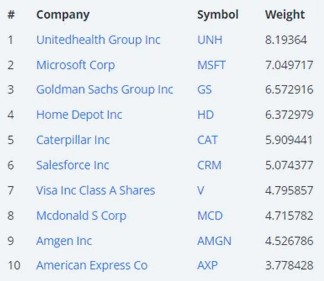
One of my main gripes with the Dow is that it only includes 30 stocks. Considering the U.S. has a few thousand publicly traded companies, I feel like picking only 30 to represent the whole market is kind of silly. However, to be fair, the 30 that are chosen do at least represent various industries and sectors. For example, just within the top 10 are companies involved in healthcare, technology, finance, retail, industrial equipment and food services.
My other main gripe with the index is how it determines the weighting of the 30 stocks. Whereas the S&P 500 weights its constituents by market cap, the Dow weights its constituents by share price.
In other words, the larger a stock’s share price, the larger it’s representation in the Dow. Share price is an arbitrary thing that doesn’t directly relate to the size or importance of the company. Whereas market cap DOES directly relate to company size. More specifically, market cap measures the size of the company’s total amount of stock outstanding.
The other issue with being weighted by share price is the fact that stocks with really high share prices essentially can’t be included in the Dow, because they would completely dominate and skew the weightings. That’s a big part (maybe the sole part) of the reason why Amazon wasn’t included in the Dow until only this year. Amazon has been one of the largest and most well-known companies in the U.S. for a decade or more, yet its share price was a few thousand dollars up until it had a 20-for-1 stock split in 2022. It wasn’t until the split that Amazon’s share price was small enough to be included in the Dow without completely overweighting itself.
So, is the Dow a BAD index? No, I don’t think it’s bad, per se. But I don’t think it’s good, either. Or at least, we have a much better index that more accurately represents the U.S. stock market (i.e. the S&P 500), so why do we need the Dow???
In case you’re wondering how the returns of the Dow have compared to the returns of the S&P 500, here is how each has performed over the last 10 calendar years. The Dow is in blue, the S&P 500 is in red (chart from www.portfoliovisualizer.com).
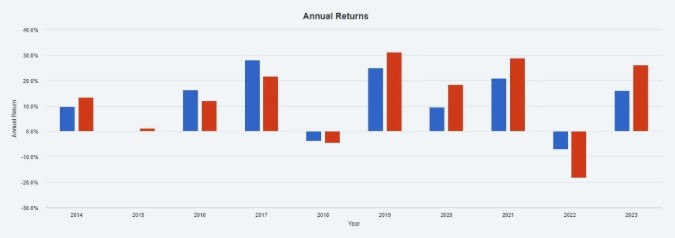
As you can see, they have historically trended fairly close to one another, though with some obvious departures here and there.
In closing, what’s the point in still having the Dow, and why is it often the first index referenced by financial media like CNBC when they give their daily updates of the stock market?
In my opinion, the Dow is given the level of attention it gets mainly out of habit and history. It’s always been around and, for better or worse, it’s ingrained in the fabric and collective psyche of investors and the financial media outlets who feed them information.
Does that mean you shouldn’t pay attention to the Dow? Maybe, maybe not. But don’t try to read into anything if the Dow is doing better than the S&P 500, or vice versa. For what it’s worth, I feel the returns of the S&P 500 are arguably the most representative of the U.S. stock market as a whole. The returns of the Dow are really nothing more than the blended returns of a kind of arbitrarily concocted basket of 30 stocks of large companies from across different industries.
Disclaimer:
None of the information provided herein is intended as investment, tax, accounting or legal advice, as an offer or solicitation of an offer to buy or sell, or as an endorsement, of any company, security, fund, or other securities or non-securities offering. The information should not be relied upon for purposes of transacting securities or other investments. Your use of the information is at your sole risk. The content is provided ‘as is’ and without warranties, either expressed or implied. Tenon Financial LLC does not promise or guarantee any income or particular result from your use of the information contained herein. Under no circumstances will Tenon Financial LLC be liable for any loss or damage caused by your reliance on the information contained herein. It is your responsibility to evaluate any information, opinion, or other content contained.